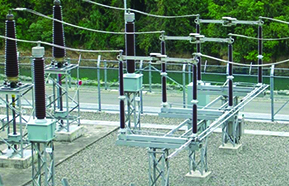
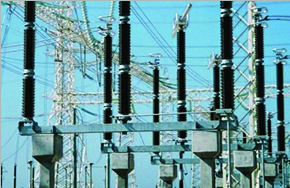
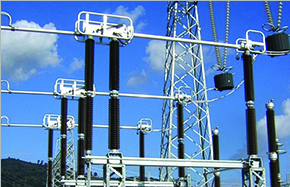
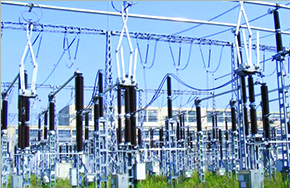
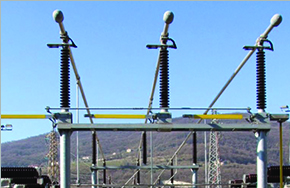
The centre-break disconnector consists of two arms which, by moving in a coordinated way on a plane which is perpendicular to that of the insulators supporting them, close the circuit at a point which is located approximately mid-way.
This is the most commonly used type of disconnector in the world, thanks to the simplicity of its design, which makes it particularly cheap. Its movement, however, requires a bigger phase-to-phase spacing compared to that required for other disconnectors with the same rated voltage.
Rated voltage: 36 - 550 kV
Rated normal current: up to 5000 A
Rated short-time withstand current: up to 63 kA (3 s)
Double-break (CTB and STC)
The double-break disconnector consists of one arm which is moved by the central insulator supporting it and closes the circuit on two fixed contacts, each of them placed on one of the two side insulators.
Two models are available:
the TCB, where the arm moves only perpendicularly to the plane of the insulators up to direct engagement of the moving contacts into the fixed ones;
the STC, where the arm, upon completing its movement perpendicularly to the plane of the insulators, rotates around its own longitudinal axis leading to complete engagement and locking of the moving contacts into the fixed ones.
The former (TBC) is characterized by an extremely simple design and it is rather cheap; the latter (STC) can provide very high performance levels, in particular under short-circuit conditions.
Rated voltage: 17.5 - 550 kV
Rated normal current: up to 4000 A
Rated short-time withstand current: up to 75 kA (3 s)
Vertical-break (SLOB and SHD)
The vertical-break disconnector consists of one arm which, by moving on the plane of the insulators supporting it, closes the circuit on a fixed contact located on the side insulator.
Since the movement of the arm takes place on the same plane as that of the insulators, the phase-to-phase spacing is minimized.
Two models are available:
the SHD, where the arm is operated by a driving insulator directly connected to it, which moves on the same plane as that of the two post insulators;
the SLOB, where the arm is operated by the rotation of the driving insulator around its own longitudinal axis, by means of a rod-crank system.
The former (SHD) is characterized by an extremely simple design and it is rather cheap; the latter (SLOB) can provide very high performance levels, in particular under short-circuit conditions.
Two different types of the SLOB disconnector are available (depending on the rated voltage and the rated short-time withstand current):
"single-motion" type, where the arm of each pole moves only perpendicularly to its rotation axis up to direct engagement of the moving contact into the fixed one;
"double-motion" type, where the arm, upon completing its movement perpendicularly to its rotation axis, moves along its longitudinal axis leading to complete engagement and locking of the moving contact into the fixed one.
Rated voltage: 17.5 - 550 kV
Rated normal current: up to 4000 A
Rated short-time withstand current: up to 75 kA (3 s)
Pantograph (VR2D)
The pantograph disconnector consists of two articulated half-arms which, by moving in a coordinated way and "vertically" on the plane of the insulators, close the circuit on a fixed contact connected the upper busbar.
Pantograph disconnectors are an ideal solution for connection to busbar systems, since they allow minimizing the substation area and ensure the maintenance (disconnector arms included) of the bay inside which the equipment is installed, without putting the upper busbar out of service.
Compared to the semi-pantograph disconnector (SSP), the pantograph model provides a wider contact zone which makes it suitable for substations with busbars made up with flexible conductors.
Rated voltage: 72.5 - 550 kV
Rated normal current: up to 5000 A
Rated short-time withstand current: up to 63 kA (3 s)
Earthing Switches (ES)
Earthing switches complete the range of disconnectors and can be:
either "stand-alone" (usually provided with their own post insulators);
or integrated onto any disconnector (with one, two or, in special cases, up to three earthing blades per pole).
Two different types are available (depending on the rated voltage and the rated short-time withstand current):
"single-motion" type, where the arm of each pole moves only perpendicularly to its rotation axis up to direct engagement of the moving contact into the fixed one;
"double-motion" type, where the arm, upon completing its movement perpendicularly to its rotation axis, moves along its longitudinal axis leading to complete engagement and locking of the moving contact into the fixed one.
Under special circumstances, when the distance between the fixed contact and ground is very big, the earthing switches can be of semi-pantograph type (see also HVDC equipment).
Special earthing switches are available for the connection to ground of neutral points: in this case, the earthing switches are equipped with suitable insulators both under the supporting frame and along the vertical driving shaft.
Rated voltage: 17.5 - 800 kV
Rated short-time withstand current: up to 75 kA (3 s)